- No Products In The Cart
- start shopping
Raw Honey vs Organic Honey: What UK Shoppers Actually Need to Know
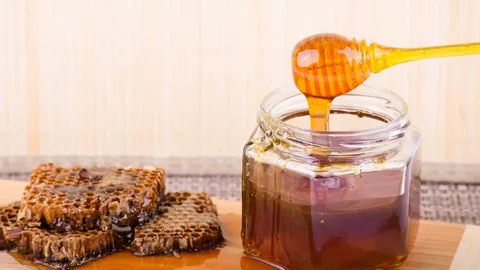
Raw honey and organic honey are not the same thing, and neither label guarantees the other. Raw honey describes how little the honey has been processed — it has not been heated above hive temperature (~35–40°C). Organic honey describes where the bees foraged and how the hive was managed — and neither label guarantees the other.
What Does “Raw Honey” Actually Mean?
Raw honey has not been heated above the natural temperature of a beehive — approximately 35–40°C — and has not been pressure-filtered. That is the industry definition, even though there is no legal definition of “raw honey” in UK or EU food law. The EU Honey Directive 2001/110/EC defines honey and sets quality standards but does not distinguish raw from processed honey as a labelling category.
Standard commercial honey is heated to between 60°C and 78°C during production. That heat keeps the honey liquid, slows crystallisation, and makes it flow through bottling machinery. It also destroys or significantly reduces three categories of compound that raw honey retains:
- Enzymes — including diastase (breaks down starch), invertase (splits complex sugars), and glucose oxidase (produces antimicrobial hydrogen peroxide when honey is diluted)
- Pollen — the botanical fingerprint that confirms where the honey came from; removed by commercial pressure filtration
- Antioxidants — including phenolic acids and flavonoids, plant-derived compounds whose concentration varies with floral source
- Propolis — a resinous compound bees use to seal the hive; retained in raw honey but removed by commercial fine filtration
Raw honey is extracted from the comb and passed through a coarse strain to remove wax and debris. The label terms that indicate genuine raw honey are: “unpasteurised,” “cold-extracted,” and “never heated above hive temperature.”
Because no UK law prevents a brand from applying the word “raw” to a mildly processed honey, the claim is only as reliable as the brand’s transparency about their exact process. A brand that states a specific maximum temperature is more trustworthy than one that simply uses the word “raw” as a front-label descriptor.
Why does raw honey crystallise, and is that a problem?
Crystallisation is a sign of genuine raw honey, not a quality defect. Pollen grains remaining in unfiltered honey act as nucleation sites — particles around which glucose molecules cluster and solidify Commercial honey crystallises more slowly because pressure filtration removes those nucleation sites.
To return crystallised raw honey to a liquid state, place the sealed jar in a bowl of warm water — below 40°C, not boiling. Water above 40°C begins degrading the enzymes you bought the raw honey to preserve.
Acacia honey is an exception: its naturally low glucose-to-fructose ratio means it stays liquid for months or years even when raw.
What Does “Organic Honey” Actually Mean?
Organic honey is honey produced under a certified farming and foraging system — one that has been independently audited and approved by an accredited certifying body. The label says nothing about how the honey was processed after it left the hive.
For a honey to carry a certified organic label, four conditions must generally be met:
- Foraging land: Bees must forage predominantly on organically managed or uncultivated land, free from synthetic pesticides, herbicides, and fertilisers.
- Hive management: Hives must be managed without synthetic veterinary treatments, and hive construction materials must meet organic standards.
- Surrounding land: The land within the bees’ foraging radius must be free from GMO crops and significant chemical inputs.
- Independent audit: A named, accredited certifying body must verify and regularly re-audit the producer’s compliance with these conditions.
In the UK, the two main certifying bodies for organic honey are the Soil Association (certifier code: GB-ORG-05) and the Organic Food Federation (certifier code: GB-ORG-04).
Organic certification is more demanding for honey than for most other food categories, precisely because bees range freely. A beekeeper growing organic vegetables can fence and manage a defined plot. A beekeeper cannot instruct bees to stop at a boundary.
One distinction matters for UK shoppers: some producers describe their honey as made “to organic principles” without holding formal certification. That phrase is a self-declaration. It carries no third-party verification, no certifier code, and no legal weight.
Only certified organic honey provides an independently checked standard.
The terms “natural,” “pure,” and “artisan” carry no regulated meaning in UK food law.
Is Raw Honey the Same as Organic Honey?
No — raw honey and organic honey describe two completely independent things.
Raw describes what happened to the honey after it left the hive — specifically, how little processing it underwent. Organic describes the conditions under which it was produced — the farming environment and hive management practices.
That creates four distinct product types:
| Raw (not heated above ~40°C) | Not Raw (pasteurised) | |
| Certified Organic | Maximum nutrient retention + certified pesticide-free sourcing. The strongest combination available. | Certified pesticide-free sourcing, but enzymes, pollen, and antioxidants are partially or fully destroyed by heat treatment. |
| Not Organic | High enzyme and antioxidant retention. No guarantee on pesticide exposure in the bees’ foraging environment. | Standard commercial honey. Nutrients reduced by heating, no farming certification, no origin traceability if blended. |
The most important practical implication sits in the top-right cell of that matrix. A health-motivated UK shopper buying a jar of certified organic honey from a supermarket may be buying a fully pasteurised product.
The word “organic” on a honey label makes no claim about the processing temperature applied during extraction and bottling. An organic honey can be heated to 70°C or above, have its pollen removed by pressure filtration, and still carry full organic certification — because organic certification governs the farm, not the factory.
Which Is Healthier — Raw Honey or Organic Honey?
Raw honey is healthier for nutrient retention; certified organic honey reduces pesticide exposure — which matters more depends on your health priority.
For nutrient retention, raw honey has the stronger case. The enzymes that give honey its functional properties — diastase, invertase, and glucose oxidase — are heat-sensitive.
Diastase activity begins declining above 49°C. The Codex Alimentarius international honey standard (CXS 12-1981, revised 2019) sets a minimum diastase activity of 8 on the Schade scale as a quality marker. Fully pasteurised honey routinely falls below this threshold.
Fresh raw honey tests at below 15 mg/kg for hydroxymethylfurfural (HMF) — a compound that forms when sugars degrade under heat. Supermarket honeys contain HMF levels approximately five times higher than honey sourced directly from beekeepers, citing Kaczmarska et al., 2021, Molecules).
Raw honey also retains bee defensin-1, an antimicrobial peptide produced by bees and added to honey during its production. Bee defensin-1 contributes to honey’s antibacterial activity alongside glucose oxidase. Both compounds are diminished by pasteurisation.
For reducing pesticide exposure, certified organic honey has the stronger case. A global survey published in Science analysed 198 honey samples from six continents and found that 75% contained detectable levels of at least one neonicotinoid insecticide. Organic certification requires that bees forage in areas free from these inputs — it does not eliminate all risk, since bees can still range beyond certified land, but it significantly reduces it.
The honest tradeoff: an organic honey that has been commercially pasteurised retains its certification but may have lower enzyme activity and reduced antioxidant content than a non-organic raw honey from the same floral source. The label “organic” is not a proxy for “more nutritious.” For shoppers who want both reduced pesticide risk and maximum nutrient retention, only raw organic honey addresses both concerns simultaneously.
Why Is There No Certified Organic Honey Produced in the UK?
No UK-produced honey currently holds organic certification, and the structural reasons are specific and verifiable.
The Soil Association requires that hives be sited so that a foraging radius of approximately 4 miles of organically managed or uncultivated land can be maintained. EU organic standards set a similar requirement at a minimum 3 km radius. In the UK, where conventional farming is intensive and land is fragmented into small parcels under varied ownership, meeting this requirement is structurally impossible for the vast majority of beekeepers.
A second barrier is specific to UK beekeeping. Varroa destructor — a parasitic mite first detected in the UK on 4 April 1992— has since spread to infest honey bee colonies nationwide.
Without active management, an infested colony will usually die within two to three years. The synthetic treatments most commonly used to control Varroa — including pyrethroid-based varroacides such as Apistan (containing tau-fluvalinate) — are incompatible with organic hive management standards. Organic certification permits only organic acid-based treatments such as oxalic acid and thymol. UK beekeepers face a practical choice between protecting their colonies and maintaining the chemical-free hive environment that organic certification requires.
The practical consequence for UK shoppers is direct: every jar of certified organic honey on a UK shelf has been imported. The UK imports the large majority of the honey it consumes, with China, New Zealand, Mexico, and Eastern European countries among the primary suppliers.
Importing certified organic honey means food miles. A jar of certified organic honey shipped from New Zealand carries a measurably higher carbon footprint than one from a UK apiary. For UK shoppers who want to avoid both pesticide exposure and food miles, the practical alternative is traceable local raw honey from a named UK beekeeper who follows organic principles in their hive management. Choose one who can demonstrate that approach — without the formal certification that UK geography makes unachievable.
From our own sourcing experience working directly with UK beekeepers, the most useful question to ask is not “is it certified organic?” — the answer will always be no. The better question is: “Where exactly are your hives sited, and how do you manage Varroa?” A producer who answers that with specific named locations and a clear management protocol is demonstrating the transparency that certification is designed to require.
Raw Honey, Organic Honey, or Both: Which Should You Actually Buy?
For nutrient retention, choose raw; for pesticide-free sourcing, choose certified organic; for both, look specifically for raw organic honey with a visible certifier code on the label.
Three scenarios clarify the decision:
- If nutrient retention is your priority: choose raw honey. Look for “unpasteurised,” “cold-extracted,” or “never heated above hive temperature” on the label. A named country or region of origin is a stronger quality signal than “a blend of EU and non-EU honeys.” Buy from a brand that publishes its processing temperature, not one that uses “raw” as a front-label term without supporting detail.
- If pesticide-free sourcing is your priority: choose certified organic honey. Look for a named certifying body code on the label — GB-ORG-04 (Organic Food Federation), GB-ORG-05 (Soil Association), or the equivalent code from the exporting country. No certifier code means the honey is not certified organic, regardless of what the front label says.
- If both matter: look for honey explicitly labelled as both raw and certified organic, with a traceable single origin and a named certifying body. These products exist — typically from Eastern European, South American, or Mediterranean producers who hold organic certification and extract without heat treatment.
The honest trade-off for UK shoppers: choosing certified organic honey means choosing an imported product. Choosing a traceable local raw honey from a named UK beekeeper means choosing higher nutrient retention and lower food miles, without the third-party pesticide guarantee that certification provides.
A small number of UK producers commission independent laboratory testing even without organic certification — and a published test result is a meaningful transparency signal that “produced to organic principles” alone is not.
How to Read a UK Honey Label: What to Look For and What to Ignore
In 2023, the European Commission reported that nearly half of honey samples tested across 20 countries were suspected of being adulterated with sugar syrup — and all 10 UK-packed samples tested were included in that finding. Knowing what each label term actually means is the most practical defence a UK shopper has.
| Label Term | What It Actually Means |
| Raw / unpasteurised / cold-extracted | Not heated above ~35–40°C; enzymes and pollen preserved. No legal definition — the claim is only as reliable as the brand’s transparency about their process. |
| Organic + certifier code (e.g., GB-ORG-04 or GB-ORG-05) | Independently certified by an accredited UK body. Farming conditions have been verified and audited. This is the only verifiable organic claim. |
| Organic (no certifier code visible) | An unverified marketing claim. The honey may come from a responsible producer — but no third party has checked. |
| Pure / natural / artisan | No regulated meaning in UK food law. No verification required. Not a quality guarantee of any kind. |
| Blend of EU and non-EU honeys | Honey from multiple unspecified countries. Almost always heavily processed to create a uniform product. No traceability to a floral source or specific origin. |
| Single origin / single apiary | Traceable to one location and one set of hives. The strongest provenance signal available on a UK honey label. |
| UK Agriculture / Non-UK Agriculture | Mandatory declaration on certified organic products indicating where the agricultural ingredients were produced. “Non-UK Agriculture” on an organic honey confirms the honey is imported, as expected. |
The GB-ORG-XX code system is the most actionable verification tool available to UK shoppers. Under UK organic labelling rules, the identifying code of the certifying body must appear on the label of any certified organic product. For honey certified by the Organic Food Federation, that code is GB-ORG-04 . For honey certified by the Soil Association, the code is GB-ORG-05 . For imported organic honey, the exporting country’s equivalent code must also appear.
The single most useful rule: if a honey label claims to be organic but carries no certifier code in GB-ORG-XX format or its international equivalent, the honey is not certified organic.
When examining honey labels on UK supermarket shelves, own-brand “organic honey” products frequently carry the certifier code in small print on the reverse or base of the jar — not on the front label where the organic claim appears. Turning the jar over to find and check that code takes three seconds and is the most reliable purchase-verification action available.
Is Honey Adulteration Relevant to the Raw vs Organic Choice?
Yes — and in a specific way that affects how seriously to take each label.
The 2023 European Commission finding reflects a structural problem in the commercial honey market: price pressure on large buyers incentivises blending with cheaper sugar syrups. The removal of pollen through commercial filtration makes adulterated honey nearly impossible to trace to a country or floral source. An adulterated honey with its pollen removed has, by definition, had its origin evidence destroyed — a process the science of pollen analysis (melissopalynology) would otherwise be able to detect.
Certified organic honey and the raw label interact with fraud risk in very different ways. Certified organic honey requires a named, audited certifying body, a paper trail from hive to bottling, and regular re-inspection. That infrastructure is not a perfect fraud-prevention system — but it creates significantly more accountability than an unverified “raw” or “natural” claim. The word “raw” has no legal definition in UK law, no certifying body, and no enforcement mechanism. A brand can label any honey “raw” without any independent check. A honey labelled “certified organic” with a visible GB-ORG code has at minimum been audited by a third party with a named accountability structure.
HMF level is the closest objective, measurable marker available for detecting over-processed honey. Fresh raw honey tests at below 15 mg/kg HMF. The Codex Alimentarius sets 40 mg/kg as the maximum for temperate-climate honey. Research has found supermarket honeys with HMF levels approximately five times higher than honey obtained directly from beekeepers. A brand that publishes third-party laboratory test results — including HMF values — is providing a transparency level that meaningfully reduces adulteration risk regardless of whether the honey carries organic certification.
Frequently Asked Questions:
Can organic honey be pasteurised?
Yes. Organic certification governs farming and foraging conditions, not the processing method. A honey can carry full organic certification and still have been heated to 70°C or above during bottling. Look for honey labelled as both raw and certified organic to get both properties.
Why is there no certified organic honey made in the UK?
There is no certified organic honey produced in the UK because UK geography makes it structurally impossible. The Soil Association requires a 4-mile radius of organic or uncultivated land around hives. Most UK farmland cannot meet this. Varroa mite management also requires treatments incompatible with organic standards.
What certifier code confirms honey is genuinely organic?
Look for a GB-ORG-XX code on the label. GB-ORG-04 is the Organic Food Federation and GB-ORG-05 is the Soil Association . For imported honey, the exporting country's equivalent code must appear. No code means no certification.
Is raw organic honey worth the higher price?
Yes, for shoppers who prioritise both nutrient retention and pesticide-free sourcing. Raw organic honey addresses both concerns simultaneously — no other product type does. Verify both claims on the label alongside a named certifier code, as "organic" alone does not mean the honey is raw.
What is the difference between organic honey and honey produced to organic principles?
The difference is third-party verification. Certified organic honey has been audited by an accredited body and carries a verifiable certifier code. Honey "produced to organic principles" is a self-declared, unverified claim with no legal standing. Both may reflect responsible beekeeping, but only one provides an independently checked standard.