- No Products In The Cart
- start shopping
Pure Honey (UK) What “Pure” Means How to Buy Genuine Honey
Pure honey is honey with no added ingredients. UK honey quality criteria state: “No additions are permitted.” To buy genuine pure honey in the UK, check the ingredients line and the origin wording. Treat “tested for authenticity” as meaningful only when the seller explains what is tested and by whom.
What does “pure honey” mean in the UK (and what does it not mean)?
Pure honey in the UK means the product must meet UK honey composition and labelling rules. GOV.UK summarises the UK’s food composition standards and includes honey rules.
Featured-snippet definition (40–55 words):
Pure honey is honey with no added ingredients, such as sugar syrups, flavours, or oils. UK honey quality criteria state “No additions are permitted. Pure honey can still be sold under reserved descriptions for presentation, such as comb honey or chunk honey.
Pure honey does not automatically mean these things:
- Local or British. Origin is a separate labelling question.
- A specific processing method. UK rules include reserved descriptions linked to presentation (for example, comb honey and chunk honey). “Pure” does not name a process by itself.
| Front-of-pack term | What it tells you for sure | What it does not prove |
| Pure honey / 100% honey | UK honey quality criteria state “No additions are permitted.” | Local, single-country origin, or that it is independently tested. |
| Comb honey | Comb honey is a reserved description for presentation in UK honey rules. | Local, or that it is lab tested. |
How can I reduce the risk of buying adulterated (“fake”) honey without lab testing?
You reduce risk by checking label transparency first, then using credible testing and traceability signals, and not relying on kitchen “tests” as your main proof.
The Food Standards Agency’s honey authenticity publication describes honey as “a target for adulteration” and says there is no single universal analytical method that can detect all types of adulteration with adequate sensitivity.
- Check the ingredients line. Look for a single ingredient like “Honey (100%).”
- Find the origin wording. Some guides call this “Country of Origin Labelling (COOL)”; in UK shopping, it is the origin statement on the pack. (Source using the COOL term:
- Prefer specific origin info when it is available. GOV.UK allows “blend of honeys from more than one country” wording when you do not list each country, so blend wording gives you less country detail to check.
- Treat “tested for authenticity” as a claim that needs details. The FSA’s honey authenticity publication recommends a “weight of evidence” approach and explains that test interpretation depends on reference data and context.
- Use a minimum disclosure checklist for “tested” claims. You should ask the seller to state:
- what adulteration risk their testing targets (the FSA publication discusses honey adulteration with “sugar/syrup added” in the supply chain).
- which lab does the work (in‑house vs third‑party)
- whether testing is done per batch or only occasionally
- whether they provide a traceability reference (batch/lot) and a test summary
- Use crystallisation as a normal behaviour, not proof of origin. Holland & Barrett states crystallisation is natural and “a sign your honey is as it should be.”
- Check the seller’s transparency about sourcing. For example, a UK product page can explicitly state mixed sourcing, such as “a unique blend of EU and non‑EU honeys.”
- Check delivery terms before comparing prices. Free-delivery thresholds can change your real cost per jar. (Example: “FREE SHIPPING ON ALL ORDERS OVER £30” on a UK honey product page.
| Signal | Use it? | Why |
| Ingredients line shows only honey | Yes | It is the clearest purity check you can do instantly. |
| Origin statement is clear and current | Yes | Traceability supports a “weight of evidence” view of authenticity. |
| “Tested for authenticity” plus details (what, who, per-batch) | Yes | The details are what you can verify. |
| “Honey sinks in water” | No | It is not a buying standard or a reliable proof. |
| “Honey is flammable” | No | It is unsafe and not a buying standard. |
First-hand research observations (site-review level): On the Tropical Sun product page I reviewed for this guide, the phrase “a unique blend of EU and non‑EU honeys” appears in the product description. On the Northumberland Honey Co category page I reviewed, the multi-buy prices are stated as £9 per jar, then £8 per jar (over 3 jars), then £7 per jar (11 or more jars). On the Hilltop product page I reviewed, a free-shipping threshold is displayed as orders over £30
At Natures Oasis, we state that every batch is independently lab tested before it reaches customers. At Nature’s Oasis, we state our honey is sourced from protected landscapes in Zaragoza, Spain. At Natures Oasis, we state free UK mainland delivery applies to orders over £45.
What does “blend of EU and non‑EU honeys” mean, and what label cues matter most?
“Blend of EU and non‑EU honeys” means the honey is sourced from more than one country, so you should rely more on traceability and testing clarity than on “local” assumptions.
A UK product page example uses the wording “a unique blend of EU and non‑EU honeys.”
GOV.UK states: “From 1 January 2024, you must use ‘blend of honeys from more than one country’ (or similar wording) if you decide not to list each country of origin.”
- Ingredients
- If it lists anything other than honey → skip.
- If it lists only honey → continue.
- Origin wording
- If it lists a specific country/region → note it and continue.
- If it uses blend wording → treat it as mixed-source and continue.
- Traceability
- If the seller provides batch/lot and sourcing detail → confidence increases.
- Testing claim
- If the seller claims authenticity testing, look for what is tested and whether it is per batch.
| Label phrase you might see | What it usually tells you | What to do next |
| “Honey (100%)” | One ingredient is honey. | Check origin wording and seller traceability. |
| “Blend of … honeys” | Mixed-country sourcing. | Prefer sellers who explain sourcing and traceability. |
| “Tested for authenticity” | A testing claim exists. | Look for scope: tested for what, by whom, and how often. |
Should I buy supermarket “pure honey” or honey from a local beekeeper?
You should buy honey from a local beekeeper when you want maximum provenance and distinctive flavour, and buy supermarket pure honey when you want budget-friendly consistency, then validate with label transparency.
The FSA’s honey authenticity publication recommends applying a “weight of evidence” approach and explains why interpretation depends on reference databases and context.
| Decision factor | Supermarket pure honey | Local beekeeper honey |
| Traceability | Often limited to blend wording. | Often higher if the beekeeper names the area and harvest. |
| Consistency | Often consistent year to year. | Can vary by season and forage. |
| Price | Often lower per jar. | Often higher per jar for small-batch honey. |
| Availability | Usually year-round. | Can be seasonal, especially comb. |
| Testing claims | Sometimes present, sometimes vague. | Sometimes present, sometimes absent; check for detail either way. |
“Local” does not automatically mean “tested for syrups”, and “tested” does not automatically mean “local”.
Which type of pure honey should I buy for how I’ll use it?
You should choose the type of pure honey by texture first (runny vs set/soft set vs comb), then by flavour/varietal, then by pack size.
- Runny honey (easy to drizzle).
- Soft set / creamed honey (easy to spread).
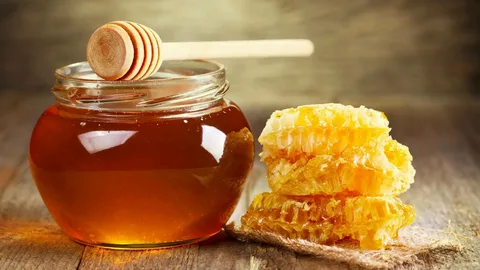
- Comb honey (a different presentation type).
UK rules recognise reserved descriptions relating to presentation, including “comb honey” and “chunk honey”.
| How you plan to use pure honey | Type that fits best | What to look for |
| Tea/coffee sweetener | Runny | Ingredients show honey only; origin wording is clear. |
| Toast and sandwiches | Soft set / creamed | A “soft set/creamed” description; ingredients still show honey only. |
| Gifting | Gift set | Clear origin and delivery terms; clear returns policy. |
| Lunchboxes / travel | Sticks or packets | Ingredient is honey only; packaging is practical for portioning. |
What should pure honey cost in the UK (and how do I compare value fairly)?
Pure honey cost in the UK is best compared using £/kg, not jar price. You also need to factor delivery thresholds and multi-buy discounts.
£/kg = price ÷ weight in kilograms
340g = 0.34kg
350g = 0.35kg
- Example A (340g jar): Hilltop shows £6.37 for “British Honey” size “Jar (340g)”.£6.37 ÷ 0.34 = £18.74/kg.
- Example B (350g jars + multi-buy): Northumberland Honey Co states jars are 350g, and states “Standard jars … £9 per jar”, “over 3 jars … £8 per jar”, and “11 or more jars … £7 per jar”.
- £9 ÷ 0.35 = £25.71/kg
- £8 ÷ 0.35 = £22.86/kg
- £7 ÷ 0.35 = £20.00/kg
- Hilltop states “FREE SHIPPING ON ALL ORDERS OVER £30”.
- The Raw Honey Shop states “Free UK delivery” when you order 3kg or more.
- Natures Oasis states free UK mainland delivery applies to orders over £45.
| Example | Price | Size stated on page | £/kg (calculated) | Delivery threshold (example) |
| Hilltop British Honey | £6.37 | 340g | £18.74/kg | Free over £30 |
| Northumberland standard jar | £9.00 | 350g | £25.71/kg | Free over £60 |
| Northumberland (11+ jars) | £7.00 | 350g | £20.00/kg | Free over £60 |
Is crystallised honey “real”, and how do I store and use pure honey safely?
Crystallised honey can be real honey, and honey must not be given to babies under 1 year.
The NHS states: “Do not give your child honey until they’re over 1 year old.”
Holland & Barrett states crystallisation is natural and “there’s nothing to worry about.”
How to make crystallised pure honey runny again (simple and gentle):
- Stand the jar in warm water.
- Aim for around 35°C.
- Leave it for 20 to 30 minutes and stir now and then.
- Keep the temperature below 43°C.
Local Honey Man’s FAQ states you should store honey “in a dry place at room temperature” with the jar securely sealed, and says: “Do not refrigerate honey.”
How do UK rules and enforcement relate to “pure honey” claims?
UK rules and enforcement set composition and labelling standards for honey, and UK authenticity work treats honey as a product that can be targeted for adulteration and mislabelling.
GOV.UK states: “Honey composition and labelling is controlled by The Honey (England) Regulations 2015.”
The FSA’s honey authenticity publication states: “No additions are permitted.”
The same publication states Product of Animal Origin imports, including honey, are subject to mandatory checks of “100% documentary; 15% minimum additional checks” by Port Health Authorities.
The same publication states honey adulteration can be direct: “sugar/syrup added” in the supply chain, or indirect via inappropriate bee feeding when nectar is available. The FSA states “no single test can definitively determine a product’s authenticity.”
- ingredients clarity
- origin clarity
- traceability detail
- testing claims that are specific enough to evaluate
Frequently Asked Questions:
What does “blend of EU and non‑EU honeys” mean?
It means the honey is sourced from more than one country (example wording on a UK product page). GOV.UK states that from 1 January 2024 you must use “blend of honeys from more than one country” if you do not list each country.
What should I look for on the jar to reduce the risk of adulterated honey?
Check the ingredients (honey only), find the origin statement, and prefer clear traceability. The FSA’s honey authenticity publication explains a “weight of evidence” approach that uses traceability and testing context, not one factor.
What does “tested for authenticity” mean—tested for what?
A good “tested” claim explains scope. The FSA’s honey authenticity publication describes adulteration routes, including sugar/syrup additions, and explains that tests have strengths and weaknesses. A weak claim is a badge with no details.
How do I compare honey prices fairly across 340g, 500g, and 1kg jars?
Convert to £/kg. Divide price by weight in kilograms (340g = 0.34kg; 500g = 0.5kg; 1kg = 1kg). Then compare like-for-like and include delivery thresholds. (Example 340g pricing:
Is crystallised honey still good, and how do I make it runny again?
Holland & Barrett states crystallisation is natural and not a sign something is wrong. It advises warming the jar in warm water, aiming for 35°C, for 20 to 30 minutes, and keeping the temperature below 43°C.