- No Products In The Cart
- start shopping
Raw Honey vs Pure Honey: What the Labels Actually Mean
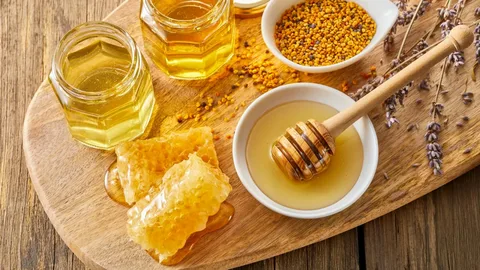
Raw honey and pure honey differ in how they are processed: raw honey is never heated above 40–48 °C and is only lightly strained, preserving its natural enzymes, pollen, and antioxidants, while pure honey is pasteurised and filtered, meaning it contains no added ingredients but retains fewer natural compounds. Neither term is legally defined under UK honey labelling law.
What Is Raw Honey?
Raw honey is honey extracted from the hive and poured straight through a coarse mesh or nylon cloth to remove wax, debris, and bee parts. That is the only process it undergoes. It is never pasteurised, never fine-filtered, and never heated above the temperature of the hive — which food standards bodies cite at no higher than 40–48 °C (104–118 °F).
Because pollen grains, micro-particles of wax, and natural glucose crystals remain suspended in the jar, raw honey looks noticeably different from supermarket honey. It is thick and opaque, with a colour that shifts from pale gold to deep amber depending on which flowers the bees foraged. Pull open a jar of Scottish heather raw honey and the colour is a rich, dark rust — a shade and texture that disappears once pasteurisation is applied.
Because raw honey also retains bee propolis and royal jelly — compounds the bees produce and deposit in the comb — it carries a broader range of naturally occurring substances than any pasteurised honey can.
The terms “untreated honey” and “unpasteurised honey” are used interchangeably with “raw honey” in UK retail contexts. “Unfiltered honey” is a related but distinct term: an unfiltered honey is not necessarily raw, and a raw honey is not necessarily entirely unfiltered. The safest definition is the one consistent with UK food standards: raw honey has not been heated above its natural hive temperature and has not been ultrafiltered.
What Is Pure Honey?
Pure honey means only one thing: nothing extra has been added to it. No corn syrup, no cane sugar, no glucose syrup, no flavouring agents. That is the full extent of the “pure” claim.
The word “pure” on a UK honey label says nothing about whether the honey has been heated, how heavily it has been filtered, or whether it retains pollen and enzymes. This is not a loophole — it is the law, or more precisely, the absence of law. The Honey (England) Regulations 2015 do not define “raw” or “pure” as regulated quality grades. A 2024 UK tribunal confirmed that Trading Standards noted “raw” was not one of the categories of honey defined and permitted for sale under those Regulations.
Because neither term carries a technical standard, two jars labelled “pure honey” can be strikingly different products. One may have been warmed once at 45 °C and lightly filtered; another may have been pasteurised and ultrafiltered to a glass-clear liquid.
Most commercial pure honey is heated to between 63 °C and 71 °C to kill yeast cells, dissolve crystals, and make the honey easier to pump through fine filters. The result is a clear, smooth, runny product with a longer shelf life and a uniform appearance across every jar. “100% honey” on a label is functionally equivalent to “pure honey”: it signals no adulteration, not minimal processing.
Raw Honey vs Pure Honey: The Key Differences
The distinction between raw honey and pure honey comes down to heat and filtration. Raw honey is never heated above 40–48 °C and is only coarsely strained. Pure honey is pasteurised and fine-filtered.
| Attribute | Raw Honey | Pure Honey |
| Processing | Strained only; not pasteurised | Pasteurised and filtered (once or twice) |
| Heat applied | Never above 40–48 °C (104–118 °F) | Typically 63–71 °C (145–160 °F) |
| Filtration level | Coarse strain (removes wax and debris) | Fine filtration (removes pollen, air bubbles, micro-particles) |
| Appearance | Cloudy, opaque, variable colour | Clear, smooth, uniform amber |
| Texture | Thick; may be set or semi-solid | Runny and liquid |
| Enzyme content | High — glucose oxidase, diastase, and invertase retained | Reduced — heat-sensitive enzymes degraded |
| Pollen content | Present | Removed by fine filtration |
| Added ingredients | None | None |
| Crystallisation rate | Faster (pollen particles act as nucleation sites) | Slower (filtration removes nucleation particles) |
| Shelf life | Indefinite if sealed and stored correctly; crystallises faster | Stays liquid longer; indefinite when properly sealed |
Two measurable markers tell food scientists whether honey has been over-processed: diastase activity and hydroxymethylfurfural (HMF).
Diastase is an enzyme present naturally in honey. Its activity falls when honey is heated. The Honey (England) Regulations 2015 specify a minimum diastase activity of not less than 8 Schade units. This matches the threshold set by the Codex Alimentarius international honey standard. Research confirms that when honey is heated to 71 °C, diastase activity drops by 60% or more within 15 minutes.
HMF (hydroxymethylfurfural) is a compound that forms when honey is exposed to heat. Fresh, minimally processed honey has very low HMF levels. The Honey (England) Regulations 2015 set the maximum HMF in honey at 40 mg/kg — levels above this indicate excessive heat treatment or prolonged poor storage.
Is Raw Honey Healthier Than Pure Honey?
Raw honey retains more enzymes, pollen, and antioxidants than pure honey because it is never heated above 40–48 °C. The specific compounds are glucose oxidase, diastase, flavonoids, and phenolic acids. Research confirms that pasteurisation at 71 °C causes diastase activity to drop by 60% or more within 15 minutes, and that heating to 78 °C reduces total polyphenol content by 12–18% and decreases antioxidant capacity by 15–30%.
The honest counterpoint: the magnitude of the nutritional difference in a typical daily serving — a teaspoon of around 7 g — is modest. No large-scale randomised controlled trial has directly compared health outcomes between people who consume raw honey versus pure honey over time. Pure honey still contains small amounts of vitamins, minerals, and antioxidants. It remains a meaningfully healthier sweetener than refined white sugar.
On glycaemic index (GI), the botanical source of honey — not its processing — is the dominant driver of GI value. Peer-reviewed analysis confirms that “raw” versus “pasteurised” does not change GI, because GI is determined by the fructose-to-glucose ratio, which pasteurisation at 63 °C does not alter.
Honey GI ranges from approximately 32 (acacia) to over 70 depending on floral source, with an average across varieties of around 55–58. A UK shopper comparing raw and pure honeys from the same floral source will find no meaningful GI difference between them.
How Do Raw Honey and Pure Honey Look and Taste Different?
Raw honey is cloudy and opaque; pure honey is clear and smooth. Raw honey is thick, variable in colour from pale straw to deep amber, and may crystallise in the jar. Pure honey is uniformly golden and stays runny for longer, because pasteurisation and fine filtration remove the pollen particles and air bubbles that cause variation.
On taste, raw honey has more character. Because it retains the volatile aromatic compounds and pollen from specific flowers, each raw honey reflects the plant it came from. A raw Scottish heather honey has a distinctively tannic, slightly peaty quality with a lingering floral depth that disappears in pasteurised versions. Pure honey, stripped of those aromatic compounds through heat and filtration, tastes generically sweet — milder, more uniform, and interchangeable between jars.
In UK supermarkets, you will also see labels that say “clear honey,” “set honey,” “runny honey,” and “soft-set honey.” These terms describe texture and physical state, not processing intensity or raw status. A jar labelled “clear honey” is almost certainly pasteurised and fine-filtered. “Set honey” means the honey has crystallised — this applies to both raw and pasteurised honeys and does not confirm raw status.
How to Read a UK Honey Label: What “Raw” and “Pure” Actually Tell You
To find raw honey on a UK label, look for the word “raw” or “unpasteurised” — the word “pure” alone tells you nothing about heat treatment. Because neither “raw” nor “pure” is a legally defined grade under the Honey (England) Regulations 2015, the burden falls on the shopper to decode labels correctly. A jar labelled “pure honey” tells you only that nothing has been added — it says nothing about pasteurisation or filtration.
- Look for the word “raw” explicitly. If the label does not say “raw,” the honey is almost certainly pasteurised, regardless of what other claims appear on the packaging.
- Look for “unpasteurised” or “never heated above hive temperature.” These phrases confirm raw status with more precision than “raw” alone, because they name the specific process that has not been applied.
- Count the ingredients. A genuine raw or pure honey has exactly one ingredient: honey. Any additional items indicate the product is not 100% honey.
- Do not treat “pure,” “natural,” or “100% honey” as raw indicators. These claims confirm only that nothing has been added. They are silent on heating and filtration.
- Check the producer’s website or label for provenance and method. Small-batch and artisanal producers who describe cold extraction, gravity straining, and no applied heat are the most reliable source of genuinely raw honey.
- Be cautious with imported “organic” honey. Organic certification requires that bees forage on organically grown plants — it does not prohibit pasteurisation.
Does Crystallised Honey Mean It’s Raw?
Crystallisation is a strong indicator of minimal processing, but it is not proof that honey is raw. Raw honey crystallises faster than pure honey because pollen particles and microscopic wax fragments remain in suspension after straining, acting as nucleation sites around which glucose crystals form and grow. Pasteurisation and ultrafiltration remove these particles, leaving fewer nucleation points, which is why pure honey stays liquid for longer.
The important correction: a honey that crystallises is not automatically raw. Adulterated honey that contains glucose syrup can also crystallise. Use crystallisation as a positive signal alongside other label indicators, not as a standalone test.
To reverse crystallisation in raw honey without destroying its natural properties, place the sealed jar in a bowl of warm water. Keep the water temperature at or below 40 °C — the threshold above which enzymatic activity begins to degrade. Do not use a microwave and do not use boiling water. The honey will return to a liquid state without losing the compounds that define it as raw.
Raw Honey vs Pure Honey: Which Should You Buy?
Raw honey is the better choice when you are eating it cold and want the fullest nutritional profile. Drizzled on yoghurt, stirred into room-temperature water, spread on toast, or taken directly from a spoon, raw honey delivers its enzymes, pollen, and antioxidants intact.
If you are baking honey into flapjacks, stirring it into a hot marinade, or adding a spoonful to freshly boiled tea, the heat you apply will destroy the enzymes regardless of whether the honey started as raw or pure. Above approximately 40 °C, glucose oxidase and diastase begin to degrade. In high-heat applications, paying a premium for raw honey provides no nutritional advantage over pure honey.
Raw honey commands a price premium because it is produced in smaller batches, requires more careful handling from hive to jar, and crystallises faster — which demands more active stock management from producers and retailers.
| Choose Raw Honey When… | Choose Pure Honey When… |
| Eating cold — yoghurt, toast, cheese boards | Baking or cooking above 40 °C |
| Taking for wellness or daily nutritional benefit | You need a long shelf life without crystallising |
| You want complex, location-specific flavour | Budget is the primary consideration |
| Drizzling over salads or cold dishes | Sweetening hot drinks |
Frequently Asked Questions
What does "raw honey" mean on a UK label?
In the UK, "raw honey" is not a legally defined term under the Honey (England) Regulations 2015 — it is a producer-defined claim. It indicates the honey has not been pasteurised and has only been lightly strained, not fine-filtered. Neither "raw" nor "pure" is a regulated quality grade in UK law.
Does crystallised honey mean it is raw?
Crystallisation strongly suggests minimal processing but does not confirm raw status. Raw honey crystallises faster because pollen particles act as nucleation sites. However, adulterated honey containing glucose syrup can also crystallise. Crystallisation is a useful signal — it is not definitive proof that honey is raw.
Is 100% honey the same as raw honey?
No. "100% honey" means no other ingredients have been added — it is equivalent in meaning to "pure." It says nothing about whether the honey has been pasteurised or heavily filtered. A jar labelled 100% honey can still have been heated to 71 °C and ultrafiltered to glass clarity.c
Can I use pure honey instead of raw honey for cooking?
Yes. When honey is added to food or drink above approximately 40 °C, heat destroys its enzymes regardless of whether it started as raw or pure. For baking, cooking, and stirring into hot drinks, pure honey performs identically to raw honey and costs less. Save raw honey for cold applications.
How do I reverse crystallised raw honey without ruining it?
Place the sealed jar in a bowl of warm water, keeping the temperature below 40 °C. Do not use boiling water or a microwave — both will degrade raw honey's enzymes. The honey will return to a liquid state without losing its raw properties.