- No Products In The Cart
- start shopping
How Is Honey Made? The 8-Stage Journey from Nectar to Jar
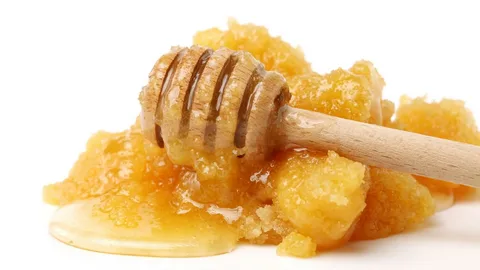
Honeybees make honey by collecting nectar from flowers, breaking its sucrose into glucose and fructose using the enzyme invertase, evaporating the water content from approximately 70–80% down to below 18.6%, and sealing the result inside wax-capped honeycomb cells. The whole process takes one to three weeks and involves thousands of bees working as a single biological system.
What Is the Raw Material Bees Use to Make Honey?
Bees transform nectar — a sugary liquid produced by flowering plants — into honey. Nectar’s three primary sugars are sucrose, glucose, and fructose, dissolved in water. Bees transform nectar into honey by adding enzymes and evaporating water, reducing moisture content from 70 to 80 per cent down to below 18 per cent, making it shelf-stable without any processing.
The sugar composition of nectar changes depending on the flower species. A plant high in sucrose produces a different honey from one whose nectar is already fructose-dominant. This variation in the sucrose-to-fructose-to-glucose ratio directly determines the final honey’s consistency, crystallisation speed, and flavour profile. Clover honey and rapeseed honey crystallise quickly because their nectar contains high glucose; acacia honey stays runny for far longer because its nectar is fructose-dominant.
Nectar is not the same as pollen. Bees collect both, but they serve entirely different roles. Nectar is the carbohydrate source — the raw material that becomes honey. Pollen is the protein source, packed into baskets on the bees’ hind legs and used to feed young larvae. Pollen never becomes honey.
How Do Bees Collect Nectar from Flowers?
Forager bees collect nectar using their proboscis — a hollow, tube-like mouthpart that works like a drinking straw. They store it in a dedicated organ called the honey stomach, also known as the crop, which holds approximately 40mg of nectar per trip. Forager honey bees collect nectar in their crop where invertase, the enzyme required for sucrose breakdown, is added from the hypopharyngeal glands.
The honey stomach is anatomically separate from the bee’s digestive stomach. A valve called the proventriculus sits between the two, keeping the stored nectar completely isolated from digestive processes. The nectar is held in suspension — no digestion occurs during transport.
All forager bees are female. They are the oldest workers in the colony, with a summer lifespan of five to six weeks. As a heavily loaded forager returns to the hive, she flies visibly lower and slower than outbound bees — a detail experienced beekeepers use to read the strength of a nectar flow by watching the hive entrance. Foragers usually stay within 3 kilometres of the hive, though they will travel up to 12 kilometres when local nectar sources are scarce.
How Do Bees Pass Nectar to Each Other Inside the Hive?
Trophallaxis is the process by which a returning forager transfers her full honey stomach contents to a younger house bee, mouth to mouth, inside the hive, with each exchange adding a fresh dose of invertase from the house bee’s hypopharyngeal glands and advancing the chemical transformation from raw nectar towards finished honey. The nectar passes between several house bees in sequence before being deposited in a honeycomb cell.
Trophallaxis is not a single handover. Dozens of bees act in relay, each regurgitating and receiving the liquid to add further enzymatic activity before it is eventually deposited in a honeycomb cell.
A common question arises: is honey bee vomit? The honest answer is that trophallaxis involves regurgitation from the honey stomach, not the digestive stomach. Because the proventriculus valve prevents any contact between stored nectar and digestive juices, the nectar never meets stomach acid. Calling honey “bee vomit” is a popular simplification that misses this anatomical distinction.
What Converts Nectar into Honey? The Enzyme Process Explained
The conversion of nectar into honey is driven primarily by a single enzyme: invertase. Invertase and glucose oxidase are secreted by the hypopharyngeal glands of honeybees — invertase for the hydrolysis of sucrose, and glucose oxidase for the preservation of honey from microbial effects.
Invertase splits each sucrose molecule — a double sugar — into one glucose molecule and one fructose molecule. The resulting glucose-fructose mixture is more chemically stable than sucrose. It creates a higher osmotic environment, and it is the form of sugar that gives honey its characteristic sweetness.
A second enzyme, glucose oxidase, works alongside invertase. It converts glucose into gluconic acid, releasing hydrogen peroxide as a byproduct. Gluconic acid is responsible for honey’s acidity, which sits between pH 3.2 and pH 4.5.
A third enzyme, diastase, is also present in honey. It breaks down starch and is used in the industry as a quality marker: diastase is destroyed by heat, so its presence in a jar confirms the honey has not been pasteurised.
How Do Bees Reduce the Water Content of Nectar?
Bees reduce the water content through wing-fanning — rapidly beating their wings over open honeycomb cells to create airflow that evaporates moisture from the stored nectar. Fresh nectar contains 70 to 80% water — far too wet to store without fermenting. House bees spread thin layers of nectar across cell walls to maximise surface area, then fan vigorously until the water content drops to the correct level.
The colony maintains its internal temperature at approximately 33–35°C, regardless of external conditions, which sustains the evaporation process even during cool British summers.
The threshold that matters is 18.6% water content — the level set by the USDA for Grade A honey and used by beekeepers worldwide as the practical harvest benchmark. Below this level, the dissolved sugar concentration is so high that osmotic pressure prevents yeast from functioning. Yeast cells cannot extract water from the surrounding solution because it is more concentrated than the cell interior — the yeast dehydrates and dies.
A beekeeper can test whether a frame is ready to harvest without a refractometer by using the shake test. Hold the frame horizontally and give it a sharp downward shake. If nectar drips from the open cells, the water content is still too high.
If the honey holds firm, the frame is ready.
One risk to understand: if a beekeeper harvests frames that are less than 80% capped, the uncapped cells likely contain honey still above the safe water threshold. Jarring honey above this level invites fermentation in the sealed jar. The wax cap is the bees’ quality-control signal — not merely a lid.
How Do Bees Seal the Honeycomb — and What Does Capping Tell a Beekeeper?
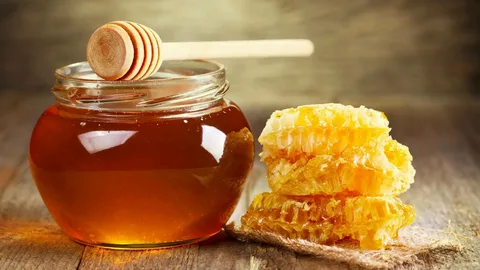
Once the water content in a cell drops to the correct threshold, bees cap it with a thin layer of beeswax. The wax is produced by glands on the underside of young worker bees’ abdomens, secreted as small flakes, and chewed into a workable material before being applied. A capped cell contains finished honey — preserved, stable, and ready to be stored for months.
The shape of each cell is hexagonal, and this is not accidental. Hexagons are the most efficient shape for dividing a flat surface into equal-area units using the least total boundary material. In practical terms, bees achieve maximum storage volume per unit of wax used. Circles waste space at junctions; squares use more wax per unit volume; hexagons strike the optimal balance. This is a formally proved result in mathematics, established in 1999 and known as the honeycomb theorem.
For the beekeeper, a capped frame is the harvest signal. An experienced beekeeper waits until at least 80% of cells are capped before extraction. Partially capped frames mean partially unripe honey, and partially unripe honey will ferment in the jar.
Why Do Bees Make Honey? The Evolutionary Purpose
Honeybees make honey to survive winter. In the UK, the foraging season runs from approximately March to October. During the remaining five months, flowering plants are largely dormant and bees cannot collect nectar.
Without a stored honey supply, a colony starves and dies before spring. First, honey is a stable, long-term energy store — raw nectar would ferment within days, but capped honey at the correct water content lasts indefinitely. Second, the colony clusters together through winter and generates heat by consuming honey and vibrating their flight muscles.
Healthy colonies overproduce honey by a considerable margin. A responsible UK beekeeper always leaves a sufficient reserve in the hive before the winter period — the colony keeps what it needs to survive, and the beekeeper takes only the genuine surplus.
How Do Beekeepers Harvest Honey — From Capped Frame to Jar?
Harvesting begins when the beekeeper confirms that frames are ready — the bees have done the work of ripening and capping, and the beekeeper’s role is to extract that finished honey without damaging the comb. According to BBKA survey data, the average honey yield per hive in the UK was approximately 31 lb (14 kg) in 2018 and approximately 24 lb (11 kg) in 2017. The long-run UK average sits at approximately 11 kg per hive per year, with a single worker bee producing only about one-twelfth of a teaspoon of honey across her entire lifespan.
The harvesting process follows six steps from capped frame to jarred honey:
- Inspect the frames. The beekeeper checks that at least 80% of cells are capped. A refractometer confirms the water content if in doubt — anything below 18.6% is safe to jar.
- Remove the frames from the hive. A smoker — a small bellows device that puffs cool smoke into the hive entrance — calms the bees. Bees are brushed or shaken gently from the frame before it is carried to the extraction area.
- Uncap the cells. A heated uncapping knife or uncapping fork slices off the wax caps, exposing the honey inside each cell. The wax cappings are collected separately — they are usable beeswax.
- Load the extractor. Uncapped frames are placed inside a centrifugal honey extractor, a drum-shaped machine with a rotating basket inside.
- Extract the honey. The extractor spins the frames at speed. Centrifugal force pulls honey out of the cells and onto the drum walls, from where it flows to the bottom. The empty comb remains intact and can be returned to the hive for the bees to refill.
- Filter and jar. Honey flows through a coarse mesh strainer to remove wax particles and any bee debris. It settles in a tank to allow air bubbles to rise, then is poured into jars. Honey extracted without heat treatment and coarse-filtered only is sold as raw honey — its enzymes (invertase, glucose oxidase, diastase) remain fully active.
Frequently Asked Questions
How long does it take bees to make honey?
Honeybees take approximately one to three weeks to convert nectar into capped, harvest-ready honey. The duration depends on colony size, ambient temperature, humidity, and the volume of nectar being processed. Warmer, drier conditions accelerate water evaporation and shorten the ripening time.
Is honey really bee vomit?
Honey involves regurgitation but is not technically vomit. Bees transfer nectar from a dedicated honey stomach — separated from the digestive stomach by the proventriculus valve — meaning no digestion occurs during transport. The nectar passes mouth-to-mouth between bees to add enzymes, but it never contacts digestive acids.
Why does honey never go off?
Finished honey contains less than 18.6% water, creating an osmotic environment too hostile for yeast and bacteria to survive. Its pH of 3.2–4.5 — produced by gluconic acid — provides further protection. Stored correctly in a sealed jar, honey has an indefinite shelf life.
How much honey does a UK beehive produce per year?
The long-run UK average sits at approximately 11 kg per hive per year, though individual seasons vary considerably. A single worker bee produces only about one-twelfth of a teaspoon of honey across her entire lifespan, which is why large colonies are essential to meaningful yields.
How do bees know when the honey is ready to seal?
Bees sense moisture through sensory receptors in their antennae and begin capping each cell when its water content drops to the correct level. Beekeepers use a handheld refractometer to measure water content independently and confirm that frames are ready to harvest before extraction.